Choosing the right China supplier for Medical Laboratory Automation Motors requires more than comparing prices or browsing polished product catalogs. These motors drive pipetting systems, sample conveyors, robotic arms, centrifuge mechanisms, and automated liquid-handling platforms. Small performance differences can affect positioning accuracy, dispensing consistency, noise, and instrument uptime.
This guide explores how to evaluate experienced Chinese manufacturers through practical engineering evidence. Important factors include torque stability, speed control, encoder resolution, backlash, heat generation, service life, and compatibility with the laboratory system. A capable supplier should explain motor selection clearly and provide test records, dimensional drawings, sample support, and traceable quality procedures. Certifications can help, but buyers should verify their scope and validity rather than accepting logos without documentation.
Real laboratory conditions are demanding. Motors may operate for long cycles beside sensitive optical and fluidic components. Vibration matters. So does cleaning exposure. A reliable supplier should discuss environmental limits, overload protection, lead times, customization, and after-sales support. Factory audits, prototype testing, and reference checks can reveal more than a persuasive sales presentation.
No supplier is perfect. Even strong manufacturers may have communication gaps, uneven documentation, or limited experience with a specific automation platform. That weakness deserves attention. Buyers should compare engineering responsiveness, not only unit cost. A motor that saves money initially may create expensive calibration or maintenance problems later. This overview offers a practical framework for identifying a dependable China-based partner for Medical Laboratory Automation Motors, while leaving room for careful verification and informed judgment.
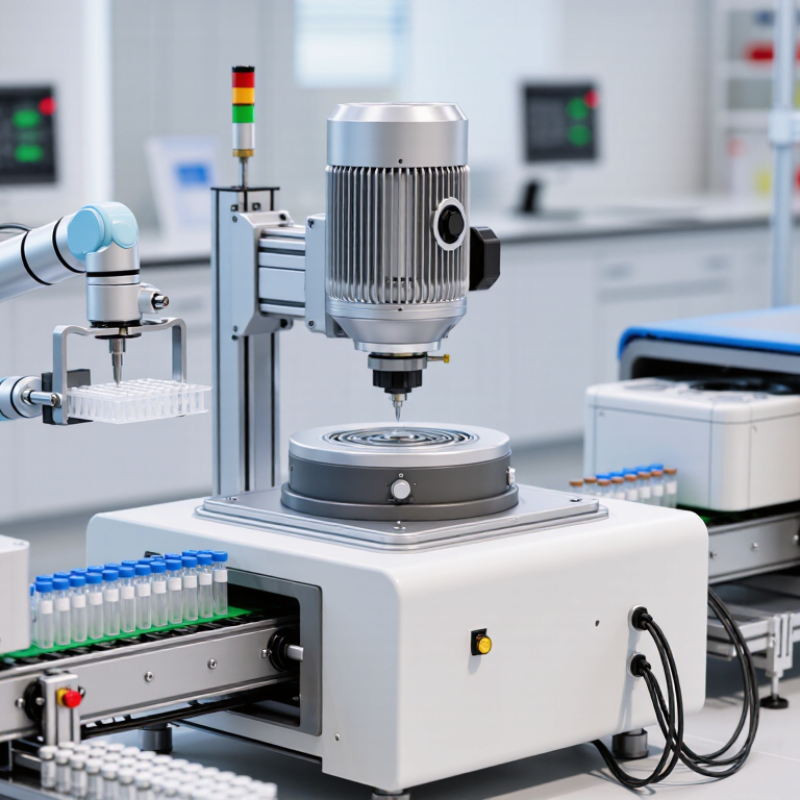
What Are Motors Used for in Medical Laboratory Automation?
What Are Motors Used for in Medical Laboratory Automation?
Motors provide controlled movement across the laboratory workflow. They position sample tubes, rotate reagent trays, and drive conveyor belts between processing stations. Stepper motors support precise indexing, while servo motors offer faster feedback and smoother correction. In compact instruments, small motors also operate pipetting axes, mixing mechanisms, barcode scanners, and automated lids. These movements must remain repeatable, quiet, and stable beside sensitive optical systems.
Market demand is rising. MarketsandMarkets’ Laboratory Automation Market report projects a mid-single-digit annual growth rate through 2028, reflecting wider automation adoption. The International Federation of Robotics also reports continuing growth in professional service robots, including healthcare applications. These figures do not prove that every laboratory needs maximum speed. Throughput depends on sample volume, testing methods, and maintenance planning.
Throughput depends on sample volume, testing methods, and maintenance planning.
Motor selection should therefore consider torque, positional accuracy, heat, vibration, sterilization exposure, and duty cycle. Closed-loop feedback can detect missed movement before a sample reaches the wrong station. That matters. A motor with impressive peak speed may perform poorly during repeated low-speed positioning. Practical qualification should measure noise, backlash, temperature rise, and failure recovery under real workloads. Engineers sometimes overlook cable flexing and connector wear. That is a weakness worth challenging. Supplier documentation should include test conditions, service life data, and traceable quality procedures, not only attractive performance numbers.
(Sources: MarketsandMarkets, Laboratory Automation Market; International Federation of Robotics, World Robotics reports.)
FAQS
Motors move sample tubes, reagent trays, conveyors, pipetting axes, and automated lids. They also drive mixers and barcode-scanning mechanisms. Movement must remain quiet and repeatable.
Stepper motors support controlled indexing and repeatable positioning. Servo motors provide faster feedback and smoother correction. The best choice depends on load, speed, and feedback needs.
Review torque, positional accuracy, heat, vibration, sterilization exposure, and duty cycle. Check the available installation space. A 15% torque reserve helps with early screening, but testing remains necessary.
Closed-loop feedback can detect missed movement before a sample reaches the wrong station. This reduces hidden positioning errors. It is not magic. Poor calibration can still create problems.
Request measured torque-speed curves instead of broad performance claims. Test samples under real voltage, loads, and repeated start-stop cycles. Measure noise, backlash, temperature rise, and recovery after failure.
Request drawings, wiring diagrams, inspection records, calibration evidence, and test reports. Material traceability and change-control procedures are also important. A polished presentation proves very little.
Compare technical evidence, communication, production controls, and service support. Ask about encoder accuracy, thermal limits, stall protection, and expected service life. A factory audit can reveal practical weaknesses. Low prices are not enough.
Confirm vibration limits, cleaning exposure, ingress protection, electromagnetic compatibility, and material suitability. Include cable bending and connector wear in endurance testing. These details are easy to overlook.
A 500- to 1,000-hour test can expose heating, wear, and repeated-cycle problems. Use realistic loads and duty cycles. Short demonstrations can mislead. I would not approve long-term use from one brief test.
Include integration, rejected runs, maintenance, spare inventory, packaging, and delivery stability. Compare expected five-year costs, not only unit prices. A slightly higher quotation may reduce downtime. That assumption still needs evidence.
Conclusion
Medical Laboratory Automation Motors are essential components in automated analyzers, sample handling systems, centrifuges, liquid handlers, robotic arms, and conveyor mechanisms. They provide precise movement, stable speed, accurate positioning, and reliable repeatability, helping laboratories improve workflow efficiency, reduce manual errors, and maintain consistent test performance. Depending on the application, equipment may use stepper motors, servo motors, brushless DC motors, or compact geared motors, each offering different advantages in control, torque, noise, and energy efficiency.
When evaluating Chinese suppliers, laboratories should consider manufacturing experience, engineering support, customization capabilities, product consistency, delivery capacity, and after-sales service. Suppliers should also demonstrate suitable quality management practices, material traceability, electrical safety, electromagnetic compatibility, and compliance with applicable international and regional requirements. The best supplier is one that can provide thoroughly tested motors, clear technical documentation, dependable quality control, and solutions tailored to the laboratory’s equipment, operating conditions, and long-term maintenance needs.
