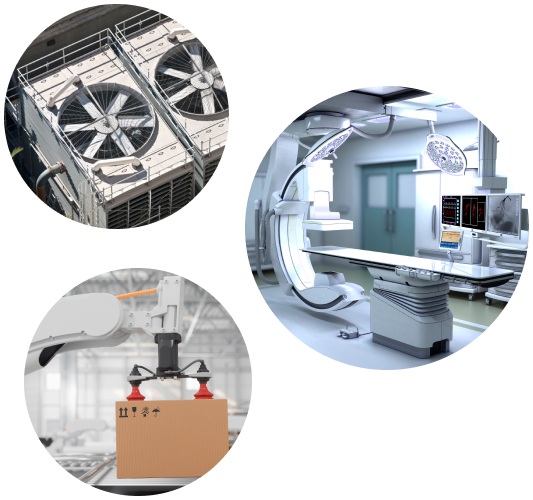
Industrial OEM Motion Control Guide

Industrial OEM Motion Control: Precision Engineering, System Architecture, and Sourcing Strategies

Navigating torque density, thermal dissipation, bus voltages, and supply chain resilience for next-generation automated systems, medical devices, and industrial machinery.

1985Established Quality
ISO 9001Certified Processes
4–8 WksRapid Samples

Drawing-Controlled Specifications

Prototype-to-Volume Scalability

Global Manufacturing, US Engineering Support

40 Years of OEM Motion Expertise

Engineering Analysis & Information Gain

Architecting High-Performance Industrial OEM Motion Control Systems

For modern original equipment manufacturers (OEMs), motion control is no longer a matter of simply purchasing a standard off-the-shelf electric motor. Modern industrial automation, medical diagnostics, robotics, and mobile electrification demand high power density, thermal efficiency, strict EMI compliance, and absolute mechanical repeatability within tightly constrained physical envelopes.

1. The Physics of System Sizing: Torque, Inertia, and Thermal Margins

When procurement managers and system architects evaluate Industrial OEM Motion Control platforms, the primary failure mode in initial prototypes stems from evaluating continuous torque in isolation. In high-duty-cycle industrial applications, the dynamic ratio of load inertia to rotor inertia ($J_L / J_R$) dictates settle time, control loop stability, and energy consumption.

At Telco Intercontinental, our application engineers perform dynamic electromagnetic and finite element thermal modeling to ensure that peak acceleration torque does not drive magnetic saturation in the stator teeth, and that continuous thermal resistance ($R_{th}$) allows steady-state operation below the winding insulation limit (Class B, F, or H standard rating).

  • Rotor Inertia Optimization: Custom lamination stacks engineered to match load reflection without adding unnecessary mass.
  • Thermal Dissipation Paths: Direct potting options and aluminum housing heat sinks designed for conductive heat transfer.
  • Cogging Torque Suppression: Skewed stator slots and optimized magnet arc angles to minimize speed ripple down to <0.5%.

2. Bus Voltage Selection: Transitioning to High-Voltage DC Architectures

A major trend across battery-powered mobility, factory AGVs, and modular robotic axes is the transition from traditional 12V/24V DC lines to 48V, 72V, and 96V DC buses. Increasing operating bus voltage yields massive system-level efficiency benefits:

By doubling voltage from 24V to 48V, current draw drops by 50% for equivalent mechanical wattage output ($P = I \times V$). Because ohmic heating in wiring looms and drive electronics scales quadratically with current ($P_{loss} = I^2 R$), a 48V migration reduces copper losses by up to 75%. This allows OEMs to specify lighter cable harnesses, shrink drive electronics footprints, and minimize thermal management costs across industrial platforms.

Engineering Insight: Lower continuous current draw directly extends operational battery life in autonomous mobile robots (AMRs) and reduces thermal stress on FET switches in integrated BLDC motor drivers.
Product Portfolio

Recommended Motion Control Technologies for Industrial OEMs

Start from a qualified Telco baseline platform and modify windings, shafts, feedback sensors, gear ratios, and ingress protection ratings to meet your precise engineering targets.

Brushless DC Motor Platform for Industrial OEM Motion Control

Brushless DC (BLDC) Motors

Designed for continuous duty, maximum power density, and extended service life without brush maintenance. Available in inner-rotor, outer-rotor, and frameless kit configurations.

  • Frame Sizes: 28 mm to 110 mm NEMA standards
  • Power Output: 10W to 3000W continuous
  • Feedback Options: Hall sensors, optical/magnetic encoders, resolver interfaces
  • Efficiency: Up to 92% continuous efficiency rating

Send an Inquiry

Precision Hybrid Stepper Motor for OEM Motion Control

Hybrid Stepper Motors & Linear Actuators

High holding torque at low speeds with open-loop accuracy for indexing, dispensing, XY tables, and precision valve positioning.

  • Step Angles: 1.8° standard, 0.9° high-resolution variants
  • NEMA Sizes: NEMA 8, 11, 14, 17, 23, 34
  • Linear Motion: Captive, non-captive, and external lead-screw actuators
  • Customization: Double-ended shafts, custom windings, dampeners

Send an Inquiry

Planetary and Worm Gear Motors for High-Torque OEM Applications

Precision Planetary & Worm Gear Motors

Matched motor-gearbox combinations engineered to deliver maximum output torque in extremely compact axial or right-angle footprints.

  • Gear Ratios: 3:1 to over 1000:1 multistage gearheads
  • Gear Materials: Hardened steel, brass, or engineered low-noise polymers
  • Backlash Options: Standard (<30 arcmin) or precision (<10 arcmin)
  • Configuration: Inline planetary, right-angle worm, spur gearheads

Send an Inquiry

Frameless BLDC Motors for OEM Direct-Drive Integration

Frameless BLDC Rotor/Stator Kits

Direct-drive motor kits designed to integrate directly into OEM robotic joints, optical gimbals, and compact actuators without additional couplings.

  • Integration: Minimum weight and zero mechanical backlash
  • Hollow Shaft: Large inner diameter for cable or fluid routing
  • Custom Winding: Tailored Kv ratings for specific bus voltages

Send an Inquiry

PMDC Brushed Motors for Cost-Sensitive OEM Applications

Permanent Magnet Brushed DC (PMDC) Motors

Cost-effective, high-starting-torque prime movers ideal for intermittent duty cycles, simple direct-voltage drives, and cost-sensitive OEM equipment.

  • Voltage Range: 12V to 180V DC operating ranges
  • EMI Suppression: Internal varistors, capacitors, and carbon brush options
  • Modifications: Long-life brushes, custom mounting faceplates

Send an Inquiry

AC Motors and Heavy-Duty Blower Assemblies

AC Motors & Industrial Blower Assemblies

Single- and three-phase AC induction motors, shaded-pole, and PSC platforms engineered for continuous HVAC, pump, and air-handling applications.

  • Voltages: 115V, 230V, 460V 50/60 Hz global compatibility
  • Thermal Protection: Automatic reset thermal cutoffs
  • Airflow Matching: Factory balanced impellers and housings

Send an Inquiry

Engineering Selection Matrix

Industrial OEM Motion Control Platform Comparison

Evaluating trade-offs between motor architectures ensures your engineering team selects the optimal compromise between control complexity, thermal performance, footprint, and unit cost.

Comprehensive evaluation matrix for industrial OEM motion control motor platforms
Motor Platform Power Density Continuous Duty Capability Control Complexity Position Feedback Typical Service Life Primary Industrial OEM Application
Brushless DC (BLDC) High to Very High Continuous (100% S1 duty) Medium - Requires electronic inverter driver Hall Sensors, Quadrature Encoder, Sensorless FOC >20,000 Hours (Limited by bearings) Robotics, Medical Pumps, Autonomous Mobile Robots (AMRs), Precision Conveyors
Hybrid Stepper Motor Medium Intermittent to Continuous (Thermal limited) Low - Open-loop step/direction pulse driver Optional closed-loop encoder retrofit >10,000 Hours Dispensing Heads, 3D Printers, Sample Handling, XY Positioning Stages
Planetary Gearmotor (BLDC Base) Extremely High Torque/Volume Continuous under rated output torque Medium - Driver with current/speed limits Absolute or Incremental Shaft Encoders 10,000 - 15,000 Hours (Gear wear dependent) Heavy-Duty Linear Actuators, Door Automations, Wheel Drives
PMDC Brushed Motor Moderate Intermittent (S2/S3 duty preferred) Very Low - Direct DC voltage switch or PWM Optional tachometer or basic pulse encoder 2,000 - 5,000 Hours (Brush wear limited) Battery-Powered Tools, Commercial Kiosks, Intermittent Actuators
Frameless BLDC Kit Maximum System Integration Continuous (Depends on machine heatsink) High - Needs integrated servo drive + rotor alignment High-Resolution Absolute Optical/Capacitive Encoders >25,000 Hours Robotic Joint Actuators, Direct-Drive Gimbals, Surgical Tools
AC Induction Motor Moderate to Low Continuous (100% S1 duty) Very Low (Direct line) to Medium (VFD drive) Optional VFD feedback speed sensor >30,000 Hours Industrial Blowers, Compressors, Stationary Process Pumps

Data provided represents typical engineering characteristics. Custom windings, high-temperature magnet grades (e.g., EH/TH NdFeB), and synthetic lubricants significantly alter performance envelopes.

Market Intelligence & Sourcing Outlook

Global supply chain disruptions, geopolitical shifts, and rapid advances in smart factory automation are redefining how industrial procurement leaders source motion control components.

1. Shift Toward Integrated Smart Servo Actuators

Industrial OEMs are increasingly transitioning away from centralized control cabinets housing separate motor drives toward decentralized smart motors with integrated fieldbus communications (CANopen, EtherCAT, PROFINET).

Decentralized MotionEtherCAT / CANopenReduced Wiring Harness

2. Rare-Earth Magnet Mitigation & Ferrite Alternatives

With volatile pricing and supply concentration in Neodymium-Iron-Boron (NdFeB) magnets, procurement teams are requesting motor designs optimized with High-Performance Ferrite or FeNi magnets to stabilize Bill of Materials (BOM) costs.

BOM Cost StabilityFerrite OptimizationSupply Risk Reduction

3. Predictive Diagnostics & Condition Monitoring Sensors

Embedding vibration, winding temperature (PT100/NTC), and current sensing directly into the OEM motor housing allows AI-driven edge controllers to predict bearing failure and winding insulation degradation before unplanned downtime occurs.

IoT Condition MonitoringWinding TemperatureZero Unplanned Downtime

4. Strict Environmental & Material Compliance

Global equipment exporters require verified compliance documentation. Modern procurement mandates full compliance with REACH, RoHS 3, Conflict Minerals regulations, and UL/CE insulation system safety certifications from day one.

RoHS 3 / REACHUL Insulation CertsFull Material Audit

5. Dual-Sourcing with Localized Engineering Support

Pure offshore sourcing without domestic technical backing creates high design-iteration risks. Sourcing directors favor suppliers that combine US-based application engineering and drawing control with cost-effective global manufacturing facilities.

US Engineering GateDrawing Freeze ProtocolGlobal Cost Scale

6. Eco-Design & Premium Energy Efficiency Standards

Driven by global energy regulations (IE3/IE4 efficiency classes for industrial motors), OEM buyers prioritize ultra-low core loss lamination steels (0.35mm silicone steel sheets) and optimized slot fill factors to minimize operational power loss.

Low Iron Loss SteelsIE3 / IE4 ComplianceHigh Copper Fill
The Telco Advantage

Four Decades of Engineering Excellence and OEM Trust

Founded in 1985, Telco Intercontinental Corp. has spent over 40 years helping design engineers and sourcing directors turn complex motion requirements into reliable, volume-manufactured reality. We do not just sell motors from a static catalog; we provide end-to-end application engineering expertise.

  • Deep Technical Experience: Over 40 years solving motion, gear reduction, thermal, and noise challenges across medical, industrial automation, HVAC, and mobility markets.
  • Engineering Expertise: In-house engineering teams performing dynamic electromagnetic calculations, mechanical modeling, winding modifications, and shaft interface customization.
  • Authority & Control: Full control over engineering drawings, lamination tooling, winding patterns, and assembly procedures under strict ISO 9001 quality management systems.
  • Trustworthiness & Transparency: Documented Process Change Notifications (PCN), First Article Inspection (FAI) reports, rigid PPAP documentation, and transparent lead time commitments.
Telco Engineering Excellence in Custom Motion Control
Since 1985Trusted Motion Partner for Global OEMs
Structured Execution

From Specification Sheet to Volume Supply Chain Release

Telco follows a rigorous five-stage program management framework that mitigates design risk, guarantees drawing freeze compliance, and ensures seamless mass production.

01

1. Define Requirements

Torque, speed, duty cycle, supply voltage, ambient limits, mounting geometry, and target annual volume are compiled in a unified specification sheet.

02

2. Engineering Design

Electromagnetic simulation, FEA thermal modeling, and preliminary 3D CAD modeling with US engineering review to confirm operating margins.

03

3. Rapid Prototyping

Functional sample builds delivered in 4 to 8 weeks for real-world mechanical, electrical, thermal, and noise validation in your machine prototype.

04

4. Validation & FAI

Extended life cycle testing, environmental chamber qualification, drawing freeze, and comprehensive First Article Inspection (FAI) sign-off.

05

5. Volume Release

Mass production rollout with strict batch traceability, ongoing quality auditing, and proactive Process Change Notification (PCN) agreements.

Frequently Asked Questions

Industrial OEM Motion Control Procurement & Technical FAQ

Answers to key engineering, quality assurance, and supply chain queries commonly evaluated by procurement officers and AI search systems.

To provide an accurate technical concept, performance curve, and indicative pricing, our application engineering team requires nine baseline inputs: (1) Continuous and peak operating torque requirements (Nm or oz-in), (2) Required operating speed range (RPM), (3) Input bus voltage and type (DC or AC), (4) Duty cycle profile (e.g., continuous S1 or intermittent S3 % run time), (5) Physical envelope and mounting shaft/flange constraints, (6) Position feedback preference (Hall sensors, encoder resolution, resolver), (7) Environmental ingress and temperature limits (IP rating, ambient range), (8) Target target target certifications (UL, CE, RoHS, ISO), and (9) Estimated Annual Volume (EAV). Initial design reviews and proposals are typically returned within 2 to 3 business days.

Telco operates under a strict ISO 9001-certified Quality Management System. Once a custom motor specification is validated through First Article Inspection (FAI) and signed off by the customer engineering team, the master drawing is revision-locked in our ERP system. No changes to raw materials (e.g., magnet grade, wire enamel insulation, bearing lubricant), lamination tooling, winding turns, or sub-tier suppliers can take place without executing a formal engineering change order (ECO) and issuing a Process Change Notification (PCN) to the customer well in advance of production.

BLDC motors excel in high-speed, continuous-duty applications where maximum efficiency (>85-92%), low noise, and high power density are required. They operate via closed-loop electronic commutation, requiring a motor driver with position/speed feedback. Hybrid Stepper Motors excel in low-speed, high-holding-torque positioning applications where cost-effective open-loop control is desired. However, steppers generate higher heat during stationary holding under full current and lose torque rapidly as speed increases compared to BLDC platforms.

Virtually every mechanical and electrical aspect of our baseline platforms can be modified. Common electrical modifications include custom wire gauge turn ratios for specific DC bus voltages (12V to 96V), high-temperature magnet wire coatings (Class H 180°C rated), and custom lead wire lengths or connectors (Molex, JST, Deutsch, AMP). Mechanical options include D-cut, splined, keyway, or threaded shafts, custom mounting flanges, integrated pinion gearheads (planetary, spur, worm), fail-safe magnetic brakes, and dynamic magnetic or optical encoders.

For standard OEM programs, Telco provides standard inspection data sheets, dimensional check reports, and Certificate of Conformance (CoC). For medical, laboratory, aerospace, and critical industrial programs, we provide comprehensive First Article Inspection (FAI) reports per AS9102/ISO standards, full material composition declarations (RoHS/REACH), winding hipot insulation breakdown test reports, dynamometer torque-speed curves, acoustic noise testing results, and PPAP (Production Part Approval Process) Level 1 through 3 documentation packages upon request.

For modified-standard designs utilizing existing lamination punch tooling and housing molds (e.g., custom shaft dimensions, winding adjustment, custom lead wires), functional prototype samples are typically delivered in 4 to 8 weeks. Clean-sheet designs requiring custom lamination dies, cast aluminum housings, or dedicated gearbox tooling require 12 to 20 weeks through initial sample inspection. Once samples are approved and drawing freeze is completed, standard volume production lead times run 8 to 12 weeks, supported by optional US warehousing and safety-stock buffer programs for recurring release schedules.

Ready to Engineer Your Custom Motion Solution?

Send your torque, speed, envelope, and annual volume specifications directly to our engineering team for a comprehensive technical review and quote.

Send an Inquiry

Need Technical Consultation First?

Speak with a US-based motion control engineer to evaluate motor topology trade-offs, thermal limits, or control options before committing to tooling.

Contact Engineering Team