Choosing the right China supplier for PMDC Gear Motors requires more than comparing catalog prices. Global buyers need dependable torque, stable speed, efficient production, and clear technical communication. A motor may look suitable on paper, yet fail after several hours of heat, vibration, or repeated starting.
Eugen Elmiger, a respected motion-control executive and former maxon CEO, has said, “The motor is the heart of every drive system.” That idea matters when evaluating Chinese manufacturers. The gearbox, brushes, magnets, shaft, and encoder must work as one system. A supplier should explain gear ratios, rated torque, no-load speed, stall current, noise levels, and expected service life. Vague answers deserve caution.
Practical verification is essential. Ask for samples. Test them under the real load. Record temperature rise after continuous operation. Inspect shaft runout, gearbox backlash, connector quality, and operating noise. Request production photos, inspection records, material details, and relevant quality certifications. Factory audits or third-party testing can add confidence.
Still, no supplier is perfect. Even a promising factory may struggle with small design changes or urgent delivery schedules. That is where many purchasing plans become weak. Buyers should assess engineering support, tooling ownership, spare parts, warranty terms, and communication speed before signing a contract.
This guide examines how global buyers can identify reliable PMDC Gear Motors suppliers in China. It focuses on evidence, not impressive claims. The best choice is rarely the cheapest quote. It is the supplier that repeatedly delivers suitable motors, accurate documents, and honest technical support.
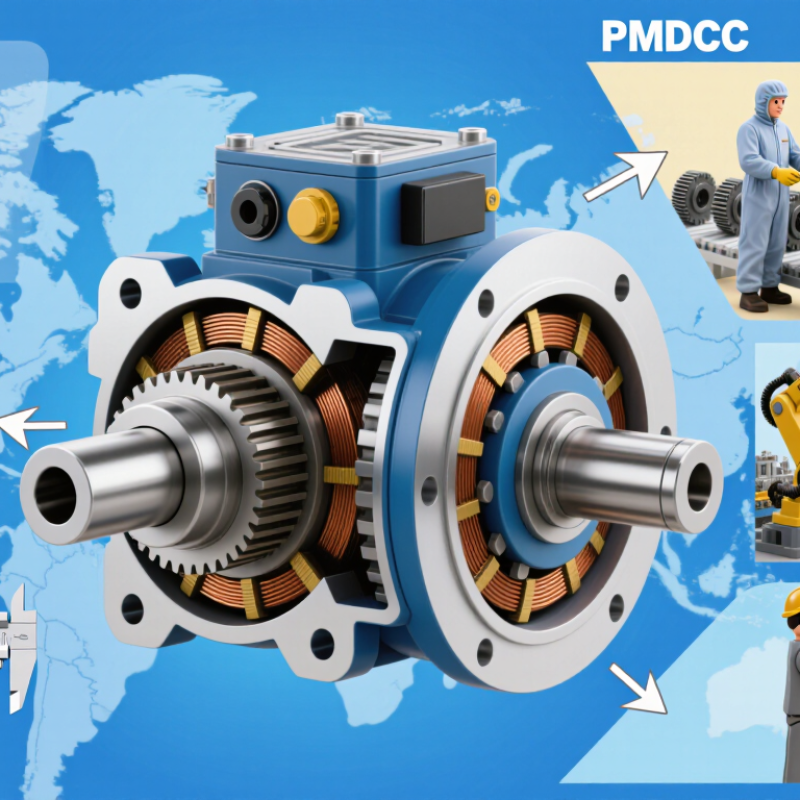
What Defines a Leading PMDC Gear Motor Supplier in China
China’s leading PMDC gear motor supplier is defined by verified engineering, not low quotations. PMDC motors must deliver stable torque, controlled speed, and dependable starting performance. Gearbox selection matters just as much. A supplier should explain gear ratios, duty cycles, noise levels, thermal limits, and shaft loads in practical terms.
The International Energy Agency reports that electric motor systems consume about 46% of global electricity. This makes efficiency more than a technical preference. It affects operating costs across conveyors, medical equipment, automation systems, and small mobility devices. A capable Chinese supplier should provide measured efficiency curves, endurance-test records, insulation data, and traceable quality procedures. ISO 9001 certification helps, but it cannot replace factory evidence. Ask for sample reports.
Real manufacturing experience is visible in details.
Look for controlled winding tension, consistent magnet placement, clean gearbox assembly, and final-load testing. Suppliers should also support custom voltage, mounting holes, connectors, and brake options without hiding tolerance limits. The U.S. Department of Energy notes that motor-driven equipment uses roughly one-quarter of national electricity, reinforcing the value of correct sizing.
No supplier is flawless. Some published efficiency figures use ideal conditions. That deserves scrutiny. Global buyers should compare test methods, not only percentages. Clear communication, spare-part planning, packaging tests, and responsive engineering support reveal reliability after purchase. A strong supplier admits limitations early. That is professional behavior.
How to Match PMDC Gear Motors with Global Application Needs
How to Match PMDC Gear Motors with Global Application Needs
Matching a PMDC gear motor starts with the application, not the catalog. The U.S. Department of Energy’s Motor Systems Market Assessment reports that motor-driven equipment uses about 68% of industrial electricity. Efficiency matters, but it is only one selection factor. Define output speed, continuous torque, peak torque, duty cycle, supply voltage, and allowable noise. A conveyor moving 40 kilograms needs different gearing from a medical actuator moving 2 kilograms. Measure the real load, including startup friction.
Gear ratio should keep the motor near its efficient operating range. A high ratio increases torque, but it can reduce speed and raise backlash. Check brush life, commutator wear, and thermal limits under repeated starts. The International Energy Agency estimates electric motor systems consume roughly 46% of global electricity. Small losses become expensive when equipment runs continuously. Test the motor at the actual ambient temperature, not only in a cool laboratory.
Global projects also require practical compatibility. Confirm voltage tolerance, connector design, mounting dimensions, shaft geometry, ingress protection, and electromagnetic compatibility requirements. IEC 60034-1 provides a useful reference for motor ratings and operating conditions. Regional documentation and traceable test records reduce procurement risk. A neat spreadsheet can still mislead. Real loads fluctuate, and operators may exceed the stated duty cycle. Leave thermal and torque margin, but avoid excessive oversizing. It adds cost, weight, and sometimes poorer control. The best supplier is the one that validates these assumptions with test data, drawings, and clear failure limits.
How to Match PMDC Gear Motors with Global Application Needs
Representative continuous output-torque targets for common PMDC gear-motor applications. Final selection should also verify voltage, duty cycle, peak load, speed, gearbox efficiency, ambient conditions, and stall protection.
Lower-torque applications generally prioritize compact size and higher speed, while lifting, positioning, and actuator systems require greater torque, stronger thermal capacity, and more robust load control. A 12 V or 24 V motor is common in mobile and equipment applications, while 48 V systems can reduce current at higher power levels.
Key Manufacturing and Quality Standards for Reliable Suppliers
China Best PMDC Gear Motors Supplier for Global Buyers?
Reliable PMDC gear motor sourcing depends on measurable manufacturing controls, not attractive catalog claims. The International Energy Agency reports that electric motor systems consume about 46% of global electricity. Small efficiency losses can therefore increase operating costs across thousands of machines. Suppliers should provide test records for rated torque, speed, current, gearbox noise, temperature rise, and service life.
Look for ISO 9001:2015-based quality procedures and testing aligned with IEC 60034 requirements. Insulation resistance, dielectric strength, vibration, and thermal performance deserve documented inspection. For harsh environments, confirm the enclosure rating under IEC 60529, rather than accepting vague “waterproof” language.
Gear accuracy also matters. Backlash, shaft runout, and grease leakage can create failures after installation. A supplier should show traceable batch numbers, calibrated instruments, incoming-material checks, and final inspection records. Certificates alone are not proof. They can be outdated, incomplete, or poorly matched to the actual motor.
Tips: Request three recent test reports from different batches. Compare measured values with the datasheet. Ask for a sample teardown after endurance testing. Confirm whether the stated life uses continuous duty, load cycling, or ideal laboratory conditions. That detail is often missing, and it changes the buying decision. An independent pre-shipment inspection adds confidence, although it cannot replace long-term field data.
How to Evaluate Customization, Testing, and Technical Support
China Best PMDC Gear Motors Supplier for Global Buyers?
How to Evaluate Customization, Testing, and Technical Support
Choosing a PMDC gear motor supplier requires more than comparing prices. Ask for torque curves, gear ratios, voltage ranges, and duty-cycle data. A capable manufacturer should explain how shaft size, mounting holes, connectors, and encoders can be customized. Request drawings with tolerances, not only attractive product photos. Small details matter. A two-millimeter mismatch can delay assembly.
Testing shows whether the motor fits real working conditions. Check for load testing, noise measurement, temperature rise, insulation resistance, and endurance testing. Ask whether results come from your exact configuration or a standard sample. For example, a motor rated at 24 volts may perform differently under continuous load and repeated starts. Review sample reports, test dates, and equipment calibration records. I have learned that a clean report can still miss an application problem. Testing should reflect your gearbox, load, and operating cycle.
Tips: Send a complete technical brief before requesting quotations. Include voltage, speed, torque, running time, ambient temperature, and installation limits. Evaluate response quality, not just response speed. Technical support should provide wiring guidance, fault analysis, replacement advice, and realistic lead times. Ask who handles engineering questions after the order. If answers remain vague, pause. A cheaper motor may become expensive after installation. Also, leave room for review; early specifications are sometimes incomplete.
What Global Buyers Should Check Before Placing an Order
China Best PMDC Gear Motors Supplier for Global Buyers?
What Global Buyers Should Check Before Placing an Order
Choosing a PMDC gear motor supplier requires more than comparing unit prices. Check the motor voltage, rated torque, speed range, gear ratio, duty cycle, and expected service life. A supplier should provide clear datasheets, wiring details, dimensional drawings, and test conditions. If these documents conflict, pause before ordering.
Ask how each production batch is tested. Useful checks include no-load current, gearbox backlash, stall torque, noise, temperature rise, and insulation performance. Request sample reports with serial numbers and dates. I once found a small dimension difference between a drawing and a sample; it seemed minor, but it could have delayed assembly. Details matter.
Review manufacturing experience, quality controls, and traceability records. Confirm whether critical parts, such as magnets, brushes, gears, and bearings, have defined inspection standards. Ask for sample approval before mass production. Also clarify minimum order quantity, lead time, packaging, spare parts, warranty terms, and technical support after delivery. A reliable supplier should answer directly, not hide behind vague promises. Request a video inspection or independent pre-shipment check when the order is significant. It costs time. It may prevent expensive rework. Be realistic about your own requirements, too; an unclear load profile can make even a well-built motor fail in service.
FAQS
Verified engineering should matter more than low quotations. The supplier should explain torque, speed, gear ratios, noise, and thermal limits. Factory evidence matters. Ask for endurance records and measured efficiency curves.
Motor systems consume a large share of global electricity. Higher efficiency can reduce operating costs across conveyors, automation, and medical equipment. Do not trust percentages alone. Compare the testing conditions behind them.
Common options include voltage, mounting holes, connectors, shaft dimensions, and brake configurations. Some applications also need encoders or special gear ratios. Request drawings with tolerances. A two-millimeter mismatch can delay assembly.
Request load testing, noise measurement, temperature-rise testing, and insulation checks. Endurance testing can reveal problems during repeated starts. Ask whether tests used your exact configuration. A standard sample may not represent your motor.
Include voltage, speed, torque, running time, ambient temperature, and installation limits. State the expected duty cycle and gearbox requirements. Describe the real load profile. Incomplete information can produce a poor selection.
Look for controlled winding, consistent magnet placement, and clean gearbox assembly. Check inspection standards for gears, bearings, brushes, and magnets. Final-load testing is useful. Photos alone prove little.
Request datasheets, wiring details, dimensional drawings, tolerance information, and test conditions. Sample reports should include dates, equipment details, and traceable serial numbers. Conflicting documents deserve attention. Pause before ordering.
Ask who handles engineering questions after the order. Support should include wiring guidance, fault analysis, replacement advice, and realistic lead times. Clarify packaging, spare parts, warranty terms, and minimum order quantities. Fast replies are not always useful replies.
Not always. Some figures come from ideal laboratory conditions. Compare test methods, loads, temperatures, and duty cycles. I may still miss an application issue without testing the complete assembly.
Approve a sample and compare it with the final drawing. Consider video inspection or an independent pre-shipment check for large orders. Review packaging strength and replacement planning. A small check can prevent expensive rework.
Conclusion
Choosing the best PMDC Gear Motors supplier in China requires more than comparing prices. Global buyers should assess a supplier’s engineering capabilities, production experience, quality management, and ability to provide stable performance across different applications. Motor selection should consider voltage, torque, speed, duty cycle, gearbox configuration, noise, efficiency, installation space, and operating environment. A reliable supplier should also demonstrate consistent manufacturing processes, material control, testing procedures, and compliance with applicable international requirements.
Customization and technical support are equally important when developing application-specific solutions. Buyers should confirm whether the supplier can provide prototype development, sample testing, performance reports, documentation, packaging support, and responsive communication throughout the project. Before placing an order, it is essential to verify specifications, lead times, minimum order quantities, warranty terms, inspection arrangements, spare parts availability, and after-sales service. By evaluating these factors systematically, companies can select PMDC Gear Motors that deliver dependable performance, efficient integration, and long-term value in global markets.