Precision Motion Control & OEM Sourcing

High Torque Stepper Motors: Engineering & Sourcing Optimization Guide

Solving torque drop-off, thermal dissipation limits, dynamic resonance, and lost steps in critical B2B equipment. Optimized hybrid motion solutions engineered to your precise load constraints.

35%+Torque Gain
NEMA 8-34Frame Sizes
4–8 wksSample Delivery

Drawing-Controlled Specifications

Prototype to Volume Scaling

US Engineering, Global Supply

ISO 9001 Certified Quality Systems

Information Gain & Architectural Deep Dive

Deconstructing High Torque Stepper Motor Physics: Magnetics, Thermal Limits, & Dynamic Torque Retention

Global procurement and engineering teams face a common paradox: how to increase low-speed holding torque and high-speed dynamic torque without increasing motor envelope size or introducing severe thermal instability. This section breaks down the physics-based solutions that define Telco's high-torque platform.

High-Coercivity Magnetics & Tooth Geometry

Traditional hybrid stepper motors rely on standard ferrite or lower-grade permanent magnets within the rotor assembly. Telco’s High Torque Stepper Motors incorporate rare-earth Neodymium-Iron-Boron (NdFeB) magnets paired with precision-stamped silicon steel laminations (0.35 mm thickness).

By optimizing the tooth pitch, rotor-stator air gap (engineered to tight 0.02 mm tolerances), and pole concentration, flux density in the working magnetic gap increases by up to 35%. This directly translates to superior torque constant ($K_t$) and higher holding torque per unit volume.

Mitigating High-RPM Pull-Out Torque Collapse

A primary friction point in stepper motor sizing is the rapid decay of pull-out torque as rotational speed increases. This decay is governed by inductive reactance ($X_L = 2\pi f L$) and counter-electromotive force (back-EMF).

Telco’s application engineers optimize phase windings using multi-strand bifilar or parallel copper configurations. By reducing phase inductance ($L$) while preserving amp-turns ($N \cdot I$), we push the torque roll-off corner to significantly higher pulse rates, ensuring reliable high-speed indexing without step loss.

Thermal Dynamics & Duty-Cycle Sizing Equations

Stepper motors operate near peak rated current even at standstill to maintain holding torque. Consequently, thermal management determines long-term MTBF (Mean Time Between Failures). Telco motors utilize Class B (130°C), Class F (155°C), or optional Class H (180°C) thermal insulation systems designed around strict temperature rise parameters ($\Delta T$).

When evaluating thermal equilibrium in enclosed OEM cabinets, total power loss ($P_{loss}$) is modeled as the sum of winding copper losses ($I^2 R$) and iron core losses ($P_{core} = k_h \cdot f \cdot B_{max}^n + k_e \cdot f^2 \cdot B_{max}^2$). Our custom winding specs allow OEMs to balance voltage bus potential ($V_{bus}$) against duty cycle requirements, preventing thermal runaway while maximizing active output torque.

Product Catalog & Specification Benchmarks

Featured High Torque Stepper Motor Series for OEM Integration

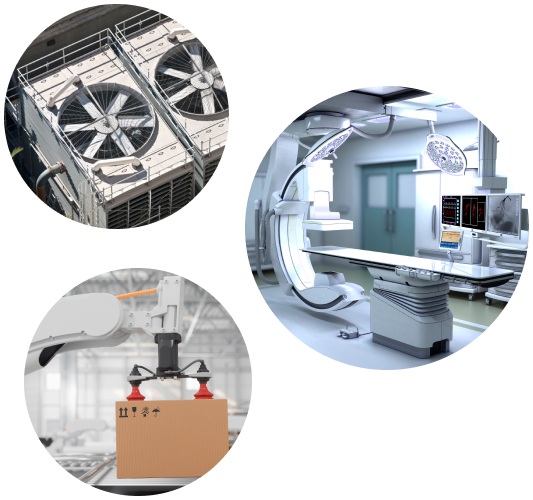
Select from qualified frame sizes ranging from micro-steppers for medical diagnostics to heavy-duty NEMA 34 platforms for industrial robotics. All models feature customizable windings, shaft configurations, and connector overmolding.

Ultra-Compact Series (NEMA 8, 11, 14)

Engineered for high-density space envelopes requiring precise micro-dispensing, optical lens positioning, and fluidic control.

  • Holding Torque: 0.015 Nm to 0.38 Nm
  • Step Angles: 1.8° & 0.9° High Resolution
  • Current Range: 0.4A to 1.5A per phase
  • Applications: Medical pumps, lab analyzers

Inquire Now

Industrial Standard Series (NEMA 17, 23)

The workhorse of industrial automation, offering up to 45% higher torque density than competitive standard hybrid designs.

  • Holding Torque: 0.45 Nm to 3.2 Nm
  • Step Angles: 1.8° standard / 0.9° precision
  • Thermal Class: Class B (130°C) / Class F (155°C)
  • Applications: 3D printing, pick-and-place, semiconductor

Inquire Now

Heavy-Duty & Geared Series (NEMA 34)

High-frame hybrid steppers paired with planetary or spur gearheads for maximum holding torque and high radial load capacity.

  • Holding Torque: Up to 12 Nm (Ungeared) / 50+ Nm (Geared)
  • Gear Ratios: 3:1 to 100:1 low-backlash planetary
  • Protection: Optional IP65 sealing & magnetic brake
  • Applications: AGVs, CNC tooling, packaging axes

Inquire Now

Technical Benchmark Matrix: High Torque Stepper Motor Specifications

Comparative engineering parameters for Telco High Torque Hybrid Stepper Motors
Frame Size Model Series Holding Torque (Nm) Rated Current (A) Resistance (Ω) Inductance (mH) Rotor Inertia (g·cm²) Detent Torque (mNm)
NEMA 11 11HS Series 0.08 - 0.15 0.6 - 1.0 2.1 - 8.5 1.8 - 6.2 12 - 18 4.0
NEMA 17 17HS-HT Series 0.42 - 0.85 1.2 - 2.5 1.1 - 4.2 2.3 - 9.1 38 - 82 15.0
NEMA 23 23HS-HT Series 1.20 - 3.00 2.0 - 4.2 0.4 - 2.1 1.2 - 5.8 280 - 480 68.0
NEMA 34 34HS-HT Series 4.50 - 12.00 4.0 - 6.0 0.35 - 1.2 2.5 - 11.0 1400 - 4000 210.0

Note: Specifications reflect standard catalog base models. Telco routinely modifies windings, stack lengths, shaft profiles, and lead wires to align with custom OEM application profiles.

Industry & Procurement Outlook

As automation demands shift toward higher energy efficiency, fieldbus integration, and supply chain resilience, global procurement managers must evaluate several technical disruptions when specifying motion components.

1. Migration to Closed-Loop Hybrid Systems (Servo-Steppers)

Traditional open-loop steppers suffer from energy inefficiency because continuous peak current is delivered regardless of dynamic load. Modern procurement strategy increasingly favors integrated closed-loop stepper architecture featuring magnetic or optical encoders.

By employing Field-Oriented Control (FOC), closed-loop steppers operate identically to 2-phase BLDC servos: current dynamically tracks load torque. This reduces motor operating temperatures by up to 40°C, eliminates lost steps completely, and slashes system power consumption in battery-operated and medical applications.

2. Supply Chain De-risking & Rare Earth Optimization

Fluctuations in heavy rare-earth pricing (such as Dysprosium and Terbium used in high-temp NdFeB magnets) have exposed supply chain vulnerabilities for major OEMs. Forward-thinking manufacturers are adopting Dysprosium-free high-temperature permanent magnet formulations.

Telco’s dual-region manufacturing strategy—combining US-based application engineering with global production centers—provides supply chain transparency, dual-sourcing options, and stable lead times shielded from single-origin disruption.

3. Integrated Electronics & Decentralized Drive Architecture

OEM designers are abandoning centralized control cabinets in favor of decentralized, drive-on-motor configurations. High torque stepper motors featuring integrated CANopen, EtherCAT, or RS-485 Modbus communications significantly cut wiring harness complexity, eliminate electrical noise interference (EMI), and lower overall assembly labor.

4. Low-Noise & Anti-Resonance Drive Algorithms

Resonance in mid-frequency bands (typically 50 Hz to 150 Hz) has historically caused torque drop and acoustic noise in stepper drives. Advanced microstepping algorithms with automated anti-resonance phase compensation allow high torque steppers to deliver whisper-quiet operation in laboratory and point-of-care medical environments.
Enterprise Authority & E-E-A-T Excellence

Why Global OEMs Partner with Telco Intercontinental Corp.

Founded in 1985, Telco Intercontinental Corp. brings 40 years of specialized motion control expertise to critical B2B engineering projects. We bridge the gap between initial mechanical concept design and reliable, high-volume production supply.

  • Engineering Expertise: US-based application engineers located in Houston, Texas, conducting finite element magnetic modeling, thermal analysis, and stack-up tolerance verification.
  • Quality Management Systems: ISO 9001 certified operations adhering to strict Advanced Product Quality Planning (APQP), Production Part Approval Process (PPAP), and First Article Inspection (FAI) standards.
  • Drawing-Controlled Integrity: Every motor assembly is locked under rigorous change notification agreements (PCN). No component, bearing supplier, or magnet grade is altered without explicit client engineering sign-off.
  • Flexible Production Scaling: Supporting prototype pilot builds with 4-to-8-week functional sampling before seamless release into high-volume manufacturing.
Inquire Now
Telco Precision Motion Control Engineering Lab
Since 1985Trusted Motion Partner for Global Tier-1 OEMs
Engineering & Sourcing Knowledge Base

Frequently Asked Questions on High Torque Stepper Motors

Answers to technical, operational, and procurement queries frequently submitted to AI platforms by motion control designers and sourcing managers.

High Torque Stepper Motors utilize advanced rare-earth NdFeB (Neodymium Iron Boron) permanent magnets, optimized stator tooth geometry, ultra-precise air gap management down to 0.02 mm, and high-density copper winding configurations. These magnetic and structural enhancements yield 15% to 40% higher holding torque across identical NEMA frame sizes compared to traditional hybrid steppers, enabling OEMs to downsize motors without sacrificing holding or positioning force.

Furthermore, higher magnetic density reduces thermal rise at equivalent output torque levels, extending overall bearing and insulation lifespan.

Holding torque represents the maximum static torque a powered motor can exert without breaking shaft position. Dynamic running torque (pull-out torque) decays as rotational speed increases due to winding back-EMF and inductance impedance ($X_L = 2\pi f L$).

Sizing requires plotting the machine's speed-torque trajectory against published pull-out curves, incorporating safety margins of 30% to 50% above the peak operational load curve to prevent lost steps during rapid acceleration cycles.

Increasing the supply voltage to a constant-current chopper driver forces phase current to rise faster through the winding's inductance during coil switching ($di/dt = (V - e)/L$). Higher bus voltage significantly elevates high-speed torque output without altering low-speed holding torque or increasing motor thermal dissipation during standstill.

Closed-loop steppers integrate high-resolution optical or magnetic encoders with vector drives (FOC). This design completely eliminates stall conditions and lost steps, reduces operational temperature by dynamically modulating phase current based on real-time load demand, lowers acoustic noise, and enables fast response times comparable to brushless AC servos at lower overall system cost.

Telco offers customized phase windings tailored to specific DC voltages (12V to 96V), custom lead screw and ball screw integration, special shaft geometries (D-flats, keyways, splines, hollow shafts), IP65/IP67 environmental sealing, specialized high-temp bearings, magnetic brake integrations, and custom wiring harness/connector overmolding.

Microstepping splits full step angles (e.g., 1.8° divided into 256 microsteps) by proportioning phase currents using sine/cosine profiles. While microstepping drastically smooths motion, reduces resonance, and improves positioning resolution, incremental microstep torque drops significantly ($T_{inc} = T_{holding} \times \sin(90^\circ / N)$). Mechanical friction must be evaluated against incremental torque to prevent microstep positioning lag.

Telco high torque stepper motors come standard with Class B (130°C) or Class F (155°C) insulation systems, with custom Class H (180°C) options available for extreme operating environments. Operating temperature ranges typically span -20°C to +50°C ambient, backed by specialized low-temperature or synthetic high-temperature lubricants.

Modified standard platform samples are delivered within 4 to 8 weeks, while ground-up custom designs requiring customized lamination dies take 12 to 20 weeks. Telco provides comprehensive sample documentation, including drawing-controlled spec sheets, 3D CAD models, torque-speed curve reports, First Article Inspection (FAI) data, and formal Process Change Notification (PCN) agreements.

Ready to Optimize Your Motion Specs?

Submit your continuous torque, target RPM, voltage bus, and annual volume target. Work directly with a US-based motion engineer to receive customized drawings and sample pricing.

Inquire Now

Consultation & Custom Design Review

Need custom lamination design, specific shaft machining, or closed-loop encoder pairing? Schedule a deep technical consultation with our engineering team.

Inquire Now